When More Supplements Become the Problem
article by Ancestral Nutrition
There was a time when supplements had a fairly simple role... they were there to supplement, to fill a gap, to support a diet that was already doing most of the heavy lifting and to offer something practical when life, travel, stress or convenience got in the way. But somewhere along the line, supplementation stopped being supportive and started becoming central.
For a lot of people, health no longer looks like food first and support second, it looks like a daily stack. Do you recognise any of these:
- Capsules before breakfast
- Powders after training
- Electrolytes in the water bottle
- Magnesium at night
- Greens in the morning
- Collagen in the coffee
- Creatine in the smoothie
- Probiotics after lunch
- Adaptogens for stress
- Something for focus
- Something for energy
And yet, despite all of it, many people still don’t feel especially well nourished which is the paradox of modern supplementation: the more people add, the less certain they often become that anything is actually working.
More Inputs, Less Clarity
One of the biggest problems with a large supplement routine is not necessarily that every product is bad it’s that once you start layering enough of them together, you lose visibility and stop knowing:
- what’s helping
- what’s unnecessary
- what’s overlapping
This is how people end up taking five different products that all promise “energy”, three that support “gut health”, and two more for “recovery”, without ever stepping back to ask whether the foundation underneath any of it is solid. And that’s where things start to go wrong.
Because if your diet is inconsistent, your meals are low in nutrient density, your sleep is average, your stress is high and your digestion is poor, then adding more isolated compounds on top rarely creates the kind of resilience people are actually looking for. It usually just creates more moving parts.
The Wellness Industry Sells in Fragments
Part of the reason this happens is because the supplement industry is built around fragments. It doesn’t sell “a deeply nourished human," it sells one nutrient, one outcome, one promise at a time:
- Low energy? Take this
- Poor focus? Take that
- Not sleeping well? Try this blend
- Skin not glowing? Add this one too
The body, however, does not operate in fragments, it works as a system.
And systems are rarely strengthened by endlessly adding isolated inputs without first asking whether the whole thing is functioning well. That’s the blind spot in the “more is better” approach.
It assumes the body is underperforming because it is missing one more product, when in reality, many people are simply undernourished at a more foundational level.
More Isn’t Always More Nourishing
This is where supplementation can become deceptive, because taking more products can create the feeling of doing more for your health, without necessarily improving the quality of your nourishment. That distinction matters.
There is a difference between:
- consuming more health products
and - being better nourished
Modern wellness often blurs the two. Someone can have a very impressive routine on paper and still be under-eating, over-relying on convenience foods, skipping real meals, or lacking the kind of nutrient density that only comes from actual food. That’s not because supplements are inherently useless. It’s because support can’t carry what the foundation fails to provide.
The Body Doesn’t Need More Hype. It Needs More of What It Recognises.
A lot of modern supplementation is built around isolated nutrients, synthetic forms, novelty compounds or highly marketed ingredients. And while some of these may have a place, there’s a point where the body is being asked to process more “interventions” than actual nourishment, that’s where whole-food nutrition becomes so important.
Because real food delivers nutrients differently:
- Not as isolated fragments
- Not as disconnected compounds
- But as complete biological packages
Naturally occurring vitamins, minerals, peptides, fats, proteins and cofactors arrive together in a structure the body has long recognised. That’s a very different experience to trying to engineer health from ten separate tubs on a shelf, and for many people, it’s exactly what’s missing.
When Health Starts to Feel Like Admin
Another sign that supplementation has gone too far is when your “wellness routine” starts to feel like a part-time job.
You need a shelf organiser, a travel pouch, a timing schedule, a spreadsheet to remember what to take with food and what to take away from coffee. At that point, the question is worth asking:
Has this actually made health simpler, or just more performative?
Because real health tends to feel grounding, not frantic, not cluttered and not like a constant attempt to keep up with your own protocol. There’s a kind of low-level exhaustion that comes from always trying to optimise.
Always trying to fine-tune and always wondering whether the next addition is the missing piece. In many cases, it isn’t. In many cases, the missing piece is simply a return to enoughness:
- Enough quality protein
- Enough minerals
- Enough nutrient density
- Enough real food.
Supplementation Works Best When It Stays in Its Lane
This is the part that often gets lost, supplements can absolutely be useful, but they tend to work best when they remain what they were always meant to be: supportive, not central.
A small number of well-chosen products can make sense, but once supplementation becomes the primary strategy, rather than the secondary one, it can start masking the real issue. And the real issue, for a lot of people, is not that they haven’t found the right stack, it’s that they’ve drifted too far from the basics.
The Smarter Question
Instead of asking: “What else should I add?” A better question is often: “What is doing the heavy lifting in my routine right now?”
If the answer is mostly powders, pills and sachets, that’s worth noticing, because the strongest health foundations are rarely built on the greatest number of products. They’re usually built on the things that look the least exciting:
- Real food
- Consistent meals
- Good sleep
- Movement
- Sunlight
- Recovery
- Nutrient density
That’s not flashy, but it works.
Final Thought
The goal of health shouldn’t be to become increasingly dependent on a growing collection of products. It should be to build a body that is well supported enough to need less intervention, not more, and that doesn’t mean rejecting supplementation entirely. It means putting it back in its proper place.
Because when more supplements become the problem, what’s usually needed isn’t another addition, it’s a return to what the body was asking for all along: real nourishment, real consistency, and less noise.
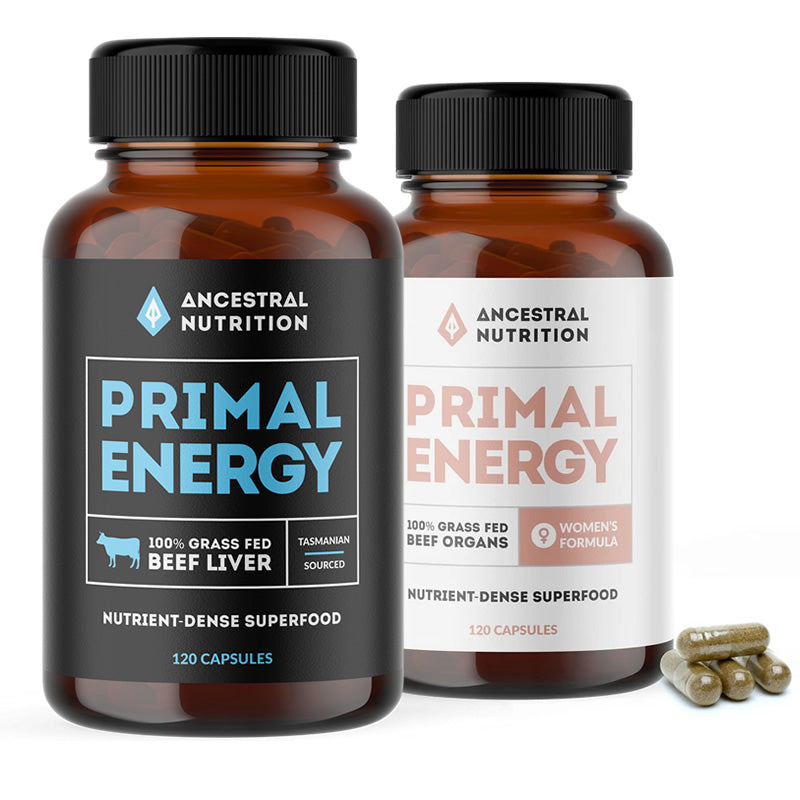
If your routine has become a shelf full of guesses, it may be time to simplify. Explore our range of whole-food, freeze-dried beef organ supplements and return to nourishment your body actually recognises:
Find our range of beef organ supplements here
*This information is for educational purposes only and is not intended to diagnose, treat, or cure any medical condition. Please consult your healthcare provider for personalised guidance, particularly if you have a diagnosed deficiency or are considering changing your supplement regimen.