The Iron Conversation Most Brands Avoid
article by Ancestral Nutrition
Iron is one of the most talked-about nutrients in modern health. Popular phrases such as low iron, high-dose iron, ultra absorbable iron are usually front-and-centre but most of the conversation focuses on one thing:
How many milligrams are you taking?
That’s not the real question, the real question is, what form is it, and can your body actually use it?
Not All Iron Is the Same
There are two primary forms of dietary iron:
- Haem iron – found in animal foods
- Non-haem iron – found in plant foods and most synthetic supplements
These forms behave very differently in the body.
Haem iron is absorbed through a specific pathway in the intestine. It’s already in a form the body recognises and can utilise efficiently. Absorption tends to be more consistent and less influenced by other dietary factors.
Non-haem iron, on the other hand, is more sensitive. Its absorption can be inhibited by compounds like phytates (found in grains and legumes), polyphenols (in tea and coffee), and even calcium. It requires conversion before it can be fully utilised.
On paper, 20 mg of iron is 20 mg of iron. In reality, form changes everything.
The Vitamin C Misconception
You’ve probably heard this advice: “Take your iron with vitamin C to improve absorption.”
This guidance applies primarily to non-haem iron. Vitamin C helps convert non-haem iron into a more absorbable state. But here’s what most brands don’t clarify:
Haem iron does not rely on vitamin C in the same way. Because haem iron is already in a bioavailable form, it uses a different absorption mechanism and is far less dependent on dietary enhancers.
Yet many iron supplements, especially synthetic forms, promote the need for added vitamin C as if it’s universally required.
It’s not.
The requirement is largely a workaround for the limitations of non-haem forms.
The Tolerance Issue
Another part of the iron conversation that often gets glossed over is tolerance. Many people experience digestive discomfort with high-dose synthetic iron including bloating, nausea, constipation. That’s not random, as certain non-haem forms can be harsher on the digestive tract, particularly in higher doses.
Haem iron, because of its distinct absorption pathway, is generally required in smaller amounts to achieve the same effect and may be better tolerated in food-based forms.
More isn’t always better, sometimes it’s just more irritating.
The “More Milligrams” Trap
Walk through a supplement aisle and you’ll see iron doses climbing higher and higher.
- 25 mg
- 40 mg
- 65 mg
It creates the impression that higher equals stronger. But absorption is regulated. The body has built-in mechanisms to control how much iron it takes in. Flooding the system with high-dose non-haem iron doesn’t necessarily mean more is utilised. It can mean more remains unabsorbed, and that’s rarely part of the marketing copy.
Context Matters
Iron doesn’t function in isolation, it works alongside:
- Vitamin B12
- Folate
- Copper
- Protein
- Other trace minerals
Whole foods naturally provide iron within this broader nutritional context.
Synthetic tablets provide iron alone, sometimes paired with vitamin C, occasionally with a B vitamin or two, but nature rarely delivers nutrients solo.
That context influences how nutrients are processed, transported, and utilised. It’s the difference between isolated chemistry and biological complexity.
The Food-First Approach
Historically, iron intake didn’t come from tablets, it came from food.
- Red meat
- Organ meats
- Nose-to-tail eating
Beef spleen, in particular, has long been recognised as one of the richest natural sources of haem iron. In whole-food form, iron is delivered within a natural matrix, alongside complementary nutrients, rather than as an isolated synthetic compound.
- No artificial fortification
- No chemical salts
- No mega-dosed shortcuts
Just iron in the form the body evolved to recognise.
The Bigger Question
If iron supplementation were as simple as swallowing a high-dose synthetic tablet, would tolerance issues be so common? Would brands need to emphasise “gentle formulas” and “added vitamin C” to compensate?
Or is it possible that the real issue isn’t iron itself, but the form it’s delivered in?
The iron conversation most brands avoid isn’t about deficiency fear. It’s about bioavailability, and context. It’s about working with physiology rather than around it.
A Smarter Way to Support Iron
At Ancestral Nutrition, we take a food-first approach.
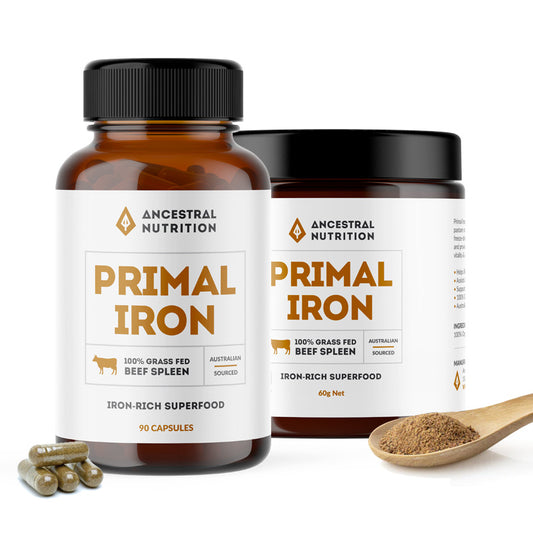
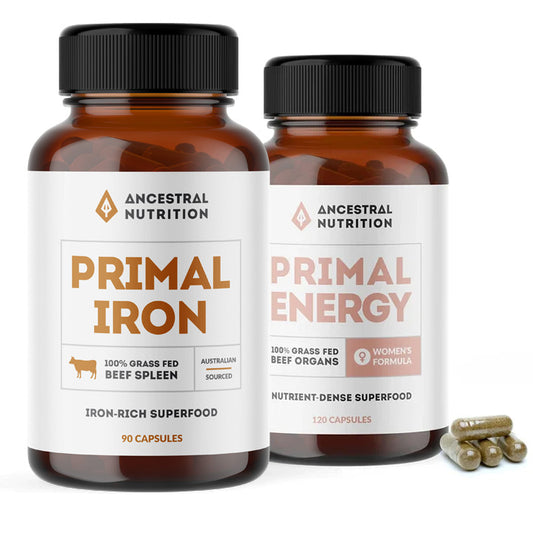
Primal Iron is made from freeze-dried, grass-fed beef spleen offering a naturally rich source of haem iron delivered in its whole-food form.
- No synthetic isolates
- No unnecessary additives
- No megadoses designed to overpower absorption
Just nutrient-dense organ food the way iron has traditionally been consumed for generations.
If you’re ready to move beyond milligram marketing and support iron the way your body recognises best, explore Primal Iron - Grass-Fed Beef Spleen and return to a more natural approach to nourishment.